Short drama apps are one of the fastest-growing content categories in mobile. Global downloads of short drama apps surpassed traditional streaming platforms for the first time in Q4 2025. Its 2026 growth trajectory is expected to remain substantial and reach $7.8 billion.
In-app advertising is the most accessible and scalable revenue layer available to the majority of short drama publishers. However, the short drama content environment has specific characteristics that make standard ad approaches underperform.
This guide covers what works, what does not, and how to monetize short drama apps in a way that generates sustainable revenue without compromising the experience that keeps audiences coming back.

How are short drama apps performing in 2026?
Surging download counts, especially in emerging markets
Short drama apps have moved well beyond a niche category and made their ways into mainstream entertainment. According to SensorTower, in Q1 2026, six short drama apps ranked among the worldwide Top 40 apps by downloads – placing them alongside major social media, AI, gaming, and OTT platforms. Global short drama downloads surpassed 850 million in Q1 2026, marking a 140% year-on-year increase.
Notably, short drama downloads are growing fastest outside mature Western markets, led by Southeast Asia, Latin America, and India.
Southeast Asia led with 32% of global downloads, followed by Latin America at 23% and India at 22% – all three posting triple-digit year-on-year growth. For publishers and advertisers, this geographic pattern signals that to best capitalize on short drama apps, they need to focus on mobile-first, high-growth emerging markets.
Deepening engagement
Users are spending a substantial portion of their time on short drama apps. Average daily time spent in short drama apps reached 25 minutes globally by April 2026, up 85% from January 2025. Southeast Asia is leading this shift, with daily engagement approaching 40 minutes per day, which is already at OTT-like levels.
This depth of engagement is what makes short drama inventory increasingly valuable to advertisers.

Intensifying competition
DramaBox and ReelShort maintained their positions as the top-grossing apps in Q1 2026, each generating close to $140 million in IAP revenue. But the competitive field is widening. Both established names like NetShort, Melolo, FreeReels, and new entrants like HotMiniDrama, BonusTV, and iDrama are scaling quickly across markets.
For publishers, this expanding competitive landscape creates both pressure and opportunity: more apps means more supply competing for advertiser budgets, but it also signals that advertisers are actively increasing their investment in the category.
Highly localized audiences
Short drama audiences vary significantly across markets. What are the audience demographics for these apps
- The US and Brazil skew strongly female, with women accounting for nearly 70% of users.
- India and Indonesia lean more male and younger, with users aged 18 to 34 making up the majority.
- Japan and South Korea show more balanced gender profiles with a larger share of older users.
These demographic differences mean that ad formats, creative approaches, floor pricing, and monetization strategies cannot be applied uniformly across markets – localization is not optional, it is a direct revenue variable.
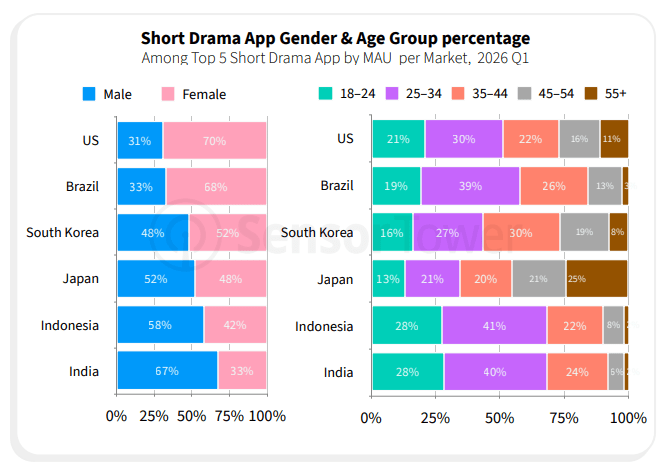
Graph: The demographics of short drama apps users (Source: Sensor Tower)
What ad formats work best in short drama apps?
The placement principle that runs across all formats
The principle for running ads in short drama apps is to place ads where the user’s attention has naturally paused, not where it is most focused. Short drama’s emotional intensity is its greatest asset as an ad environment, but that intensity should be very well preserved.
Let’s dive deeper into strategies for each ad format.
Rewarded video
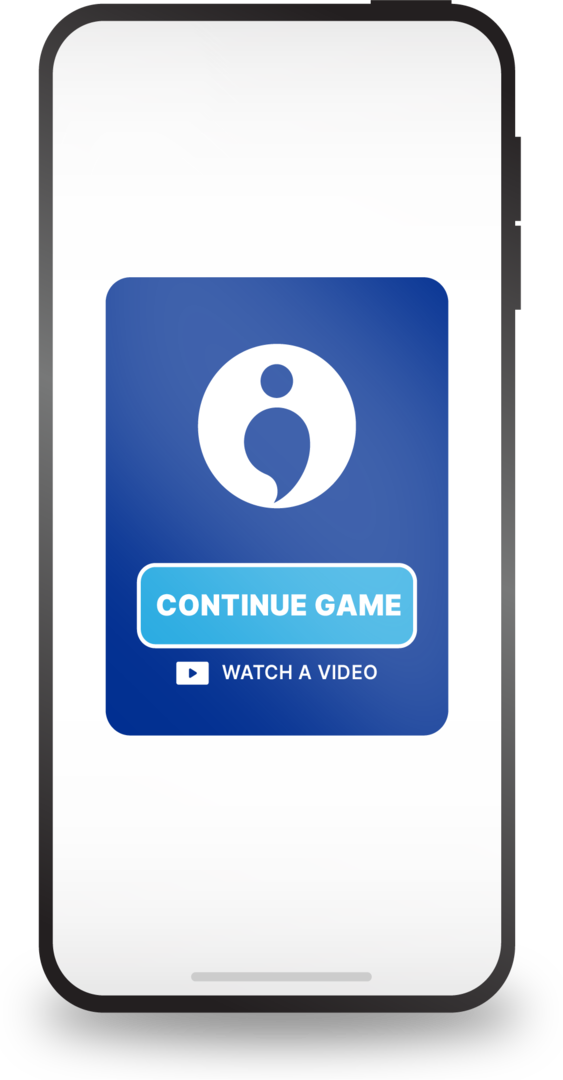
Rewarded video is the best-performing ad format for short drama apps, because it lets users trade a short ad view for a coin they’d otherwise pay for.
Short drama apps, especially those operating on a freemium basis, are built around episode unlocks, which means users pay coins or credits to access the next episode. Rewarded video maps directly onto this mechanic: instead of spending coins, a user watches an ad to earn them. The exchange feels fair and the user opts in voluntarily, which drives up eCPM as a result,
Where should they be placed?
Rewarded ads should be placed at episode-end screens where users have just finished an episode and are deciding whether to spend coins or watch an ad to continue. This is the highest-intent moment in the app, the user is emotionally invested in the story and motivated to keep watching.
What should be avoided?
Publishers should not trigger rewarded ads before a user has built any engagement with the content of the short drama app. A user who has just opened the app for the first time has no emotional investment yet, making the exchange unattractive.
Interstitials
Similar to rewarded ads, interstitial ads perform best in short drama apps when they are placed at natural breaks and pauses, such as between episodes or during a return-to-home transition. These moments make a brief full-screen ad feel like a natural transition.
Where should they be placed?
Interstitial ads’ most ideal placement is between episodes, particularly after a cliffhanger resolution when the user is deciding whether to continue. Post-episode interstitials placed before the next episode auto-loads capture high attention without disrupting the viewing experience.
What should be avoided?
Publishers are generally advised against mid-episode interstitials. Short drama episodes typically run 60 to 90 seconds. An ad that is fired mid-episode can disrupt the exact moment when emotional tension is highest, which leads to higher churn rates.

Native and in-feed ads
Native and in-feed formats are underused in short drama apps relative to their performance potential: the genre browsing and content discovery screens where users scroll through drama titles, genres, and recommendations. These spaces call for in-feed placements that blend into the content grid.
Where should they be placed?
Native and in-feed ads can be positioned within the content discovery feed, between drama title cards, and on the home screen between recommendation rows. Users in browse mode are in a lower-intensity mindset than active viewers, as they are scanning and deciding, which makes them more receptive to ads that fit the visual format of the content around them.
What should be avoided?
Native placements that visually mimic drama content closely enough to mislead users about what they are clicking can be a big turnoff. Deceptive placements damage trust quickly in a content category where users are already evaluating whether to invest emotionally in a new series.

Playable and rich media ads
Playable ads and rich media formats are not yet common in short drama apps, but the audience profile makes them worth testing – particularly for publishers with gaming and lifestyle advertiser demand in their stack.
Where should they be placed?
Playable and rich media ads can be suited for post-episode pause points and halftime breaks during extended viewing sessions, where users have natural breathing room and higher tolerance for slightly longer ad interactions. These formats require more attention than a standard interstitial, so they need the low-pressure context to perform.
What should be avoided?
Publishers should not place playable or rich media ads mid-episode or immediately before a cliffhanger resolution. These are the highest-tension moments in a short drama session and an interactive ad format requiring deliberate engagement will feel like a forced interruption.
Standard banner ads
Standard banner ads are the least preferred format in a full-screen vertical content environment. Short drama apps are designed around immersive, full-screen viewing. Therefore, a persistent banner at the bottom of the screen competes visually with the content, generates banner blindness quickly, and delivers the lowest eCPMs of any format in the stack.
Where should they be placed?
That said, there is still feasible space for banner ads – which is on non-content screens such as account pages, settings, loading screens, and non-immersive utility surfaces. These surfaces generate lower session depth, making banners a reasonably low-cost fill option without risking user experience.
What should be avoided?
What publishers should avoid is placing banners on any active viewing surface, such as episode screens, content transition screens, and post-episode screens.These are the highest-value moments in a short drama session, and filling them with the lowest-eCPM format in the stack can be counterproductive.
What factors shape floor pricing for short drama apps inventory?
Floor pricing for short drama apps should account for placement position, audience demographics, session depth, and AI-driven yield optimization.
Given short drama apps’ highly diverse audience pool, segmented floor pricing is what helps publishers make a difference. The following are the key factors that should inform any short drama app publisher’s floor pricing strategy.
Placement position
Short drama sessions have high CPM variability built into their structure. Therefore, these apps require floor pricing strategies that reflect placement-level differences so that high-intent moments are monetized effectively.
Audience composition
Short drama audiences vary meaningfully by geography and demographics, which profoundly affects advertiser demand.
For example: US and Brazilian audiences skew strongly female and older, so these apps may attract higher CPMs from fashion, lifestyle, and consumer brand advertisers.
Meanwhile, Indian and Indonesian audiences skew younger and more male, drawing stronger demand from gaming, fintech, and app install campaigns.
Session depth
In floor pricing, catering to session depth means to apply progressively stronger floors as engagement deepens, so that this signal in the auction is captured and yields better monetization outcomes.
AI-driven optimization
Managing placement-specific, geo-specific, audience-aware floor pricing manually can be resource-intensive and time-consuming. Many AI-driven yield optimization engines have been introduced to handle these processes automatically. For short drama publishers scaling across multiple markets simultaneously, this automation can define their competitive edge.
Conclusion
Short drama is one of the most favorable app categories for in-app advertising in 2026 across different ad verticals, thanks to deepening engagement level and a robust, highly diverse audience profile.
To best capitalize on short drama inventory, it boils down to three pillars:
- Choosing suitable ad formats that align with the viewing experience of short drama apps
- Timing ad placements so that ads capture user attention at its natural pause points
- Floor-price testing to best reflect the genuine variability of impression value across markets, placements, and audience segments.