
Driven by the convergence of artificial intelligence, shifting consumer expectations, and expanding digital touchpoints, the global retail media market is on a clear trajectory toward $200 billion and beyond.
This article breaks down the most important retail advertising trends for 2026 and maps out what forward-thinking brands and buyers should be focusing on today.
AI and hyper-personalization in redefining the shopper experience
In 2026, AI continues to drive the fast and scalable creation of hyper-relevant, predictive ad experiences in retail media. Brands that make good use of this capability will far outperform competitors that are relying on static creative and broad targeting.
Using first-party data signals, including purchase history, browsing behavior, loyalty program data, AI systems can serve the right product message at exactly the right moment. The result is higher conversion rates and stronger customer loyalty driven by relevance, not repetition.
Looking further ahead, brands and buyers should watch closely for the emergence of agentic commerce, which is a model where AI agents increasingly mediate the shopping journey on behalf of consumers. In this environment, sponsored placements will be negotiated and delivered via cost-per-click models tied to unified data sources that combine in-store and online behavior. This represents a fundamental shift in how ad inventory is valued and traded.
Micro-communities – The trust-based frontier of retail advertising
As mainstream social feeds become increasingly saturated, consumers are migrating toward smaller, interest-aligned spaces built on shared passion and mutual trust.
They represent highly engaged, commercially active clusters of consumers who make purchase decisions based heavily on peer recommendations. Approximately 40% of participants in micro-communities report trusting peer recommendations within those communities as much as they trust personal recommendations from close contacts.
To succeed in micro-community environments, brands must earn their place through genuine contribution. This means collaborating with community creators to develop content that serves the audience rather than interrupting it. Brands that deliver tangible value via tutorials, honest product reviews, exclusive access, meaningful discounts will build substantial voluntary advocacy.

Channel priorities – Noteworthy changes
Budget allocation in retail advertising is shifting decisively toward performance-oriented and digitally measurable channels. Understanding where investment is concentrating helps brands and buyers make smarter decisions about where to show up.
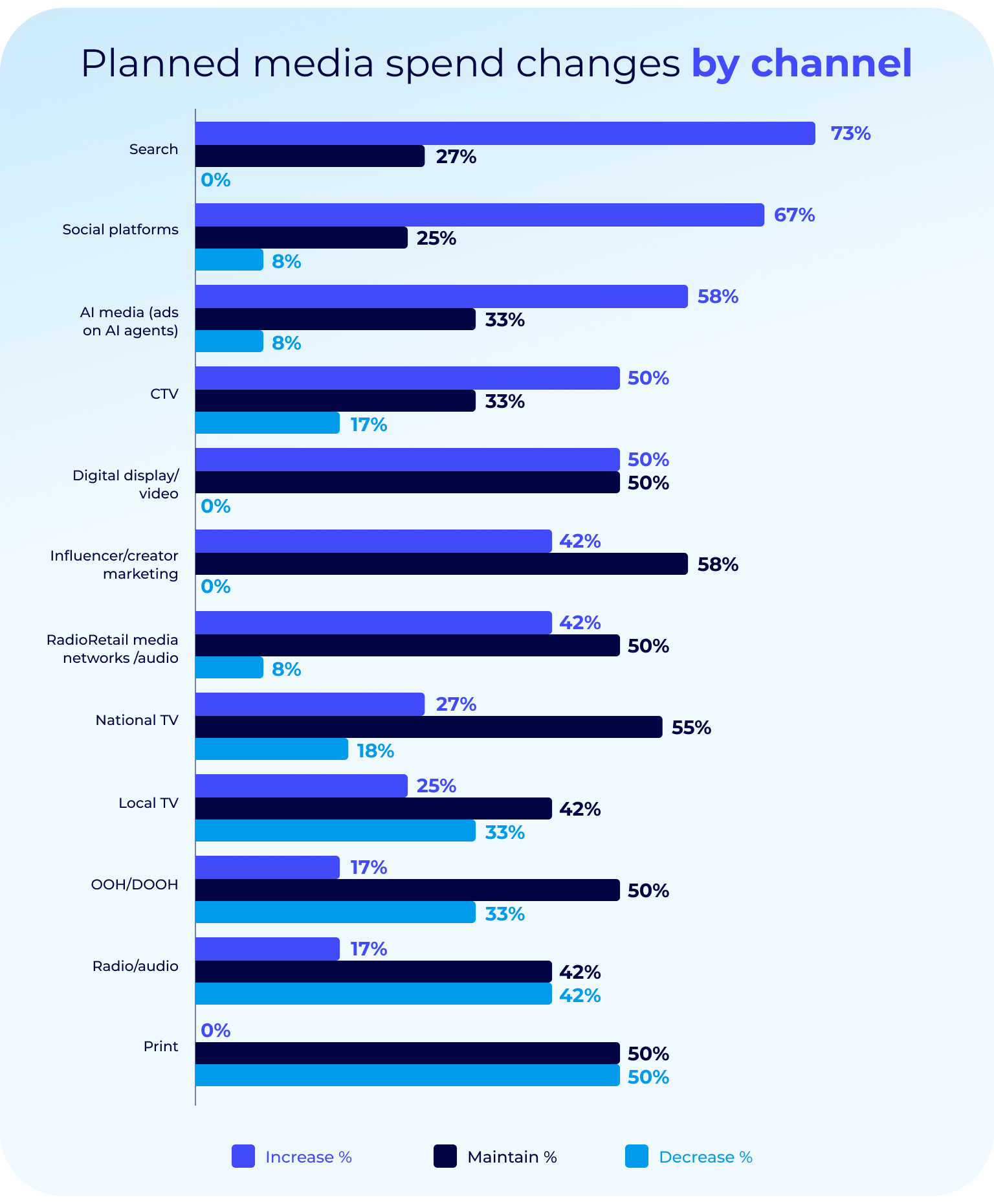
Planned media spend changes by channel (Source: Innovid)
- Search is seeing the highest investment growth of any channel at 73%, which reflects its continued strength as a high-intent, lower-funnel driver.
- Social follows at 67%. It remains a core awareness and discovery channel for product launches and seasonal campaigns.
- AI-powered media is growing at 58% as programmatic retail media advertising platforms incorporate AI-driven targeting and creative tools.
- Connected television and digital video are up 50%. They play a key role in bridging the gap between brand-building and performance measurement.
- Retail media networks and influencer partnerships are growing steadily at 42% as retailers work on establishing their own media ecosystems.
A full-funnel media strategy, where both in-store and digital channels are treated as part of a single, connected journey is the new standard approach that allows media buyers to create tangible impacts.
Sophisticated measurement’s increased accessibility
One of the biggest changes in retail advertising right now is how brands measure whether their ads are actually working.
For a long time, the most sophisticated measurement tools were only available to large retailers with big budgets and dedicated data teams. One example is the “clean room”, a secure system that allows two companies to match their customer data and learn from it, without either side having to hand over raw data to the other. It is a powerful way to understand which ads drove real purchases.
That is now changing. Clean rooms are becoming faster, more automated, and more accessible. This means mid-sized brands and retail advertising agencies can now access the same level of measurement sophistication that was once out of reach.
At the same time, the old divide between brand advertising and performance advertising is breaking down. Brands used to run awareness campaigns separately from sales-focused campaigns, often with different teams, different tools, and different metrics. Today, advertisers are advised to connect different channels and pipelines into one continuous view.
Actionable takeaways for brands in 2026 retail advertising landscape
Brands that move quickly on the following priorities will be best positioned to compete as retail advertising continues to evolve.
Invest in product data quality
As AI recommendation engines become central to retail media, well-structured product data directly affects how effectively those engines surface products to the right shoppers.
Audit first-party data strategy
First-party data underpins AI personalisation, clean room measurement, and smarter targeting. Therefore, brands that have not yet structured their approach to collecting and activating customer data should treat this as an immediate priority in their retail advertising strategy.
Move toward unified measurement
Brands running brand and performance campaigns in silos are missing out on major opportunities for conversions. A measurement framework that connects the entire shopper journey will enable smarter optimisation across the funnel.
Enter micro-communities with intent
As micro-communities grow in influence, presence alone is not enough. Brands that contribute real value through insightful, audience-aligned messaging are the ones converting community engagement into genuine buying interest, as well as building lasting brand trust in the process.

How Geniee DSP helps brands stay ahead in retail advertising
The trends shaping retail advertising in 2026 demand a platform built for scale, precision, and transparency. Geniee delivers over 80 billion monthly impressions across Asia Pacific, with a platform that integrates directly with its own SSP, which helps brands and buyers reduce intermediary costs and give them tighter control over targeting efficiency.
Brands working with Geniee gain access to verified inventory in trusted environments, complete visibility into media spend, and the tools needed to activate first-party data, measure full-funnel performance, and reach shoppers at the moments that matter most.
Conclusion
Retail advertising in 2026 is being shaped by forces that reward preparation over reaction. Brands and media buyers that invest in the right data infrastructure, embrace AI-driven personalisation, and show up authentically in the spaces where shoppers are actively engaged will be the one reaping the most value.


0 Comments